
Format and Frequency of Meetings
The high level meetings of the Movement are:
Summit Conferences, Ministerial Conferences, Ministerial Meetings in New York during the regular Session of the UN General Assembly, Extraordinary Ministerial Meetings, Ministerial Meetings of the Coordinating Bureau, meetings of the Ministerial Committee on Methodology, meetings of the Standing Ministerial Committee on Economic Cooperation and Ministerial Meetings in various fields of International Cooperation.
There are other meetings of NAM such as the meetings of the NAM-CoB in New York and the meetings of the Working Groups, Task Forces, Contact Groups and Committees that are held at different levels.
Conference of Heads of State or Government
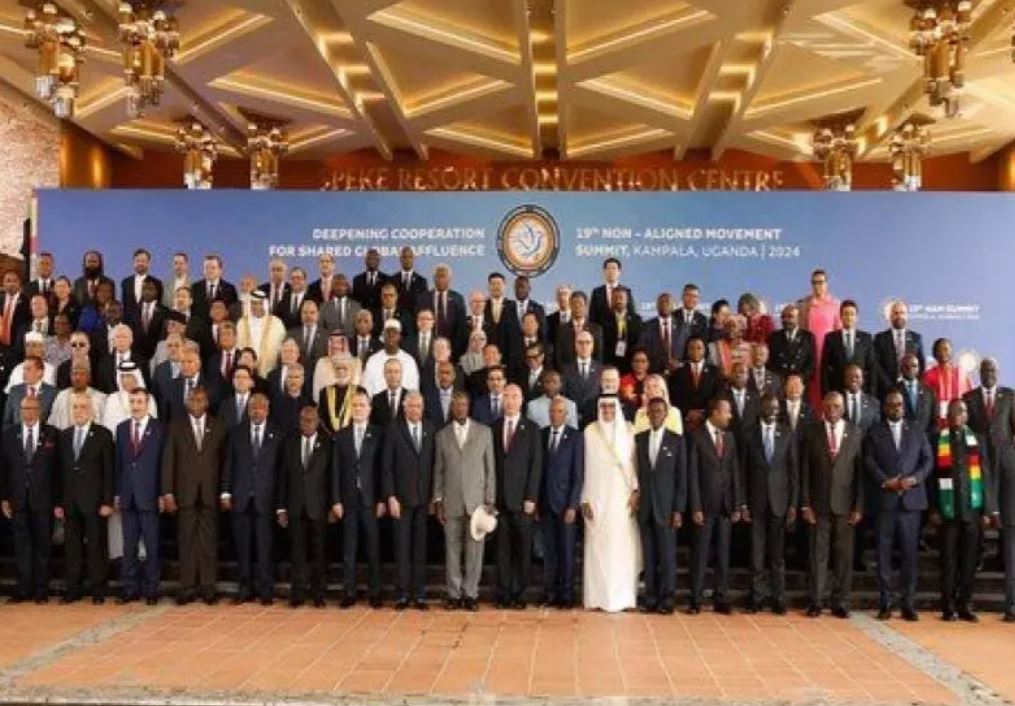
The Summit Conference of Heads of State or Government is the highest decision-making authority of the Movement. The existing practice is to hold the Summit Conference every three years. The Summit should be held at least one month before the regular Session of the UN General Assembly. The programme of the Summit includes a formal ceremony for the handing over of the Chair.
The decisions of a Summit should be action-orientated. Senior Officials and Ministerial meetings, which are preparatory to the Summit Conference, precede the Summit of the Heads of State or Government. The Summit has two committees, one for political issues and another for economic and social issues. In order to facilitate finalising the Drafts of the main documents, the committees begin their work informally during the Senior Officials meeting.
Ministerial Conference
The Ministerial Conference is held with the purpose of reviewing the developments and implementation of decisions of the preceding Summit , to prepare for the following Summit , and to discuss matters of urgency. These conferences are convened eighteen months after the Summit Conference, with the latest being the 13 th Ministerial Conference Cartagena, Colombia held 8-9 April 2000.
Ministerial Meetings in New York during Sessions of the United Nations General Assembly
It is the practice that Ministers of Foreign Affairs annually meet in New York at the beginning of the regular Session of the United Nations General Assembly. The purpose of this annual meeting is to focus on the items of the Agenda of the General Assembly that are of major importance to the Movement.
Ministerial Meeting of the Coordinating Bureau (NAM-CoB)
These meetings are restricted to preparations for Summits and, if deemed necessary, to consider issues of major importance to the Movement. The last Ministerial Meeting of the NAM-COB was held in Durban , South Africa on 27 – 29 April 2002 .
Meeting of the Ministerial Committee on Methodology
All NAM members are to be members of the Ministerial Committee on Methodology. Bearing in mind that the examination of the structure and modalities of the Non-Aligned Movement is an ongoing process, meetings of the Committee on Methodology at Ministerial level should be held as necessary upon a decision by the Summit or the Ministerial Conference. The meetings of the Ministerial Committee will be chaired by the Chairman of the Movement.
Standing Ministerial Committee on Economic Cooperation
It is necessary to revitalize the Standing Ministerial Committee on Economic Cooperation in order to strengthen south-south cooperation, reactivate the dialogue between developed and developing countries, and enhance the role of the United Nations, particularly the General Assembly, in international cooperation for development. The Standing Ministerial Committee should meet as frequently as necessary upon the recommendation of the NAM-CoB.
Ministerial Meetings in various fields of International Cooperation
Consistent with the mandates given by the Conference of Heads of State or Government, the meetings at the ministerial level shall be held on such issues as information, culture, agriculture and external debt.
Extraordinary Meetings of the Coordinating Bureau
The extraordinary meetings of the Coordinating Bureau will take place in exceptional cases which call for urgent consideration.
Meetings of the Working Groups, Tasks Forces, Contact Groups and Committees
All the existing working groups, task forces, contact groups and committees as included in the Annex make considerable contributions to the Movement. The working groups and above mentioned mechanisms should meet as often as necessary. Due consideration should be given to avoid overlapping of meetings.
The Non-Aligned Movement (NAM) was established when the leaders of 25 Non-Aligned countries plus 3 observers countries attended the 1 st Conference of Heads of State or Government of the NAM (NAM Summit) at Belgrade, Yugoslavia from 1-6 September 1961. The establishment of the NAM was very much the brainchild of Yugoslavian President Tito, Egyptian President Nasser and Indian Prime Minister Nehru and coupled with the consolidated support of Indonesian President Soekarno and Ghanaian President Nkrumah. In essence, the NAM was the product of the Cold War. It was established out of fear of nuclear holocaust perceived as the eventual outcome of the Cold War between the US-led Western bloc against the USSR-led Eastern bloc which dominated the mainstream of world politics from late 1940s until early 1990s.
NAM Summits at a glance
- First Conference – Belgrade , September 1-6, 1961
- Second Conference – Cairo , October 5-10, 1964
- Third Conference – Lusaka , September 8-10, 1970
- Fourth Conference – Algiers , September 5-9, 1973
- Fifth Conference – Colombo , August 16-19, 1976
- Sixth Conference – Havana , September 3-9, 1979
- Seventh Conference – New Delhi , march 7-12, 1983
- Eighth Conference – Harare , September 1-6, 1986
- Ninth Conference – Belgrade , September 4-7, 1989
- Tenth Conference – Jakarta , September 1-7, 1992
- Eleventh Conference – Cartagena de Indias , October 18-20, 1995
- Twelve Conference – Durban , 29 August- 3 September 1998
- Thirteen Conference – Kuala Lumpur , 20-25 February 2003
NAM Structure and Organisation
The founder member countries of NAM and their successors recognised that the Movement would probably be destroyed if they create such formal structures for the Movement, such as a constitution or charter and internal secretariat. It has been argued that a multilateral transnational organisation made up of member states with differing ideologies and purposes could never create a rational administrative structure to implement its policies that would be acceptable to all .
The Non-Aligned Movement has created a unique form of administrative style. Non-Aligned administration is non-hierarchical, rotational and inclusive, providing all member states, regardless of size and importance, with an opportunity to participate in global decision-making and world politics. The Summit is the occasion when the Movement formally rotates its Chair to the Head of State of the host country of the Summit , who then holds office until the next Summit . The Chair is at the same time also delegated certain responsibilities for promoting the principles and activities of the Movement.
By creating the practice of a rotating chair, Non-Aligned countries therefore place the onus of an administrative structure on the country assuming the Chair. When a country assumes the Chair of the Movement, it creates or designates an entire section of the Foreign Ministry to deal specifically with Non-Aligned issues. Secondly, since Non-Aligned countries meet regularly at the UN and conduct much of their work there and often consumes much of the time and activities of the Chairs’ Permanent Mission in New York .
To facilitate the Chairs’ responsibilities a number of structures aimed at improving the coordination and functioning of the existing Working Groups, Contact Groups, Task Forces and Committees of NAM were created. The structures also exist in order to promote the process of achieving a commonality of positions and interests and to see to it that Non-Aligned countries speak with one voice in international meetings and negotiations.
Coordinating Bureau (NAM-CoB)
The New York-based NAM-COB, chaired by the Chair Country of NAM, is the focal point for co-ordination of the activities of the Movement. The Heads of State or Government (HOSGs) entrusted the NAM-COB with the task, inter alia , to review and facilitate the harmonisation of the work of the various NAM Working Groups, Contact Groups, Task Forces and Committees. NAM-COB is also responsible to intensify actions in strengthening further the co-ordination and mutual co-operation among the NAM member countries, including unified action at the UN and other international fora, on issues of common concern.
Coordination by the NAM-CoB and Role of the Chair
The Chair has the responsibility of leading and coordinating the activities of NAM within the United Nations and, as appropriate, in other international fora.
Besides the Coordinating Bureau, the Chair may therefore also preside over NAM mechanisms as necessary. Working Groups could be presided over by other members. Coordination is also done in other NAM Chapters, namely in Geneva and Vienna
Working Groups, Contact Groups, Task Forces and Committees
All NAM Working Groups, Contact Groups, Task Forces and Committees meet as often as necessary. In the fulfilment of their mandates due regard is paid to coordination, efficiency and preparedness.
Non-Aligned Security Council Caucus
It is necessary that the NAM countries elected to the Security Council, and who form the NAM Caucus in the Security Council, constantly strive to adopt unified positions, and that the decisions and the positions of NAM as adopted at its Summits and Ministerial Conferences and by the Coordinating Bureau be properly reflected by them in the Security Council, without prejudice to their sovereign rights. At the Cartagena Summit the Heads of State or Government called for the need to continue to enhance this coordination, including the possibility of holding consultations on a regular basis, between members of the NAM Caucus and other members of the NAM-CoB.
The Chair of the NAM-C0B in New York should attend and address the Security Council on matters of particular importance to members of the Movement. To enlarge the scope of coordination, the Chairman of the Coordinating Bureau may at the invitation of the Non-Aligned Security Council Caucus attend the meetings of the Caucus.
The Chair of the CoB should hold regular meetings with each coordinator of the Non-Aligned Security Council Caucus with a view to being briefed on the work of the Council and in turn, to convey to the Caucus coordinator the positions of the Movement. Similarly, the Caucus coordinator should keep the Chair apprised of upcoming discussions and issues of general importance to the Movement.
The Coordinator of the Non-Aligned Security Council Caucus should also periodically brief the Movement through the NAM-CoB.
In order to promote coordination and cooperation between the NAM and the Group of 77 in promoting the interests of developing countries in international fora, a Joint Coordinating Committee of the two groups was established in 1994, which meets regularly in New York .
Coordination of Non-Aligned countries in other UN Centres
The Chair of the Movement is also responsible to give expeditious consideration to the establishment of arrangements for coordination of Non-Aligned countries in all United Nations centres and international organisation headquarters. The establishment of these arrangements facilitates coordination and cooperation with the Coordinating Bureau and enhances the role of the Movement in international fora.
At a meeting of Foreign Ministers of NAM, representing past, present and future Chairs, in New Delhi on 6 April 1997, the concept of a Troika (of the past, present and future Chairs) started to emerge. The Troika subsequently formally met for the first time in New York in September 1997 at the margins of the 52nd Session of the UN General Assembly.
Group of past, present and future Chairs (Former Chairs)
During the aforesaid meeting Ministers expressed their satisfaction with the format of the meeting of past, present and future Chairs and suggested that the Group meet more frequently as a discussion forum. It was also suggested that the Group would meet at other levels, e.g. on the level of officials to discuss issues that arise and require direction or a stance by the NAM .
The Ministers of Foreign Affairs decided at New Delhi ’97 to set up an Ad-hoc Panel of Economists from the member states of NAM to assess the current international economic situation from the perspective of developing countries as well as to identify and analyse major issues of concern to them. The Chair of the Movement ( Colombia ), in association with the host country ( India ), consulted member states of NAM on the establishment of the panel and on its programme of work and reported to the 12 th NAM Summit at Durban , South Africa in September 1998.
The Ad-hoc Panel of Economists submitted a report entitled “Elements for an Agenda of the South”, which was discussed by a Ministerial Roundtable convened specifically to discuss that document. The report identified a set of issues that should be taken into account in a new agenda for developing countries and presented to the Meeting of the Standing Ministerial Committee for Economic Co-operation.
The preparation of all documents is the responsibility of the host country and should be the object of the widest possible consultations. Host countries should aim at circulating the First Draft as early as possible but not later than one month before the meeting. Documents should be concise, non-repetitive and succinct, highlighting issues of particular importance or urgency. Emphasis should be placed on practical, action-orientated measures that could be implemented.
The Cartagena Document on Methodology, which was issued in May 1996, emphasises that the documents of Summit Conferences, which are the supreme organ of the Movement, should, while remaining comprehensive, be condensed. Every effort should also be made to avoid repetition. Separate appeals or declarations and resolutions on important issues can also be issued.
The practice of the Movement is to make all decisions by consensus. Consensus has enhanced the solidarity and unity of the Movement. This concept presupposes understanding of and respect for different points of view, including disagreement and implies mutual accommodation on the basis of which agreement can emerge by a sincere process of adjustment among member nations in the true spirit of Non-Alignment. The Cartagena Document on Methodology states that consensus, while signifying substantial agreement, does not require implying unanimity.
On sensitive issues, the NAM tradition is to pay attention to openness and the holding of extensive consultations with the broadest possible participation. The Bureau of the Meeting, with its representative capacity, should render its assistance.
NAM Welcomes Libya ‘s Elimination Of Weapons Of Mass Destruction
NAM Welcomes Libya’s Decision on Weapons of Mass Destruction
KUALA LUMPUR, March 11 (Bernama) — The Non-Aligned Movement (NAM) has formally welcomed Libya’s commitment to eliminate materials, equipment and programmes capable of producing internationally prohibited weapons.
Malaysia’s Resident Representative to the International Atomic Energy Agency (IAEA), Datuk Hussein Haniff, delivered the statement on behalf of the NAM Chapter in Vienna at the IAEA Board of Governors Meeting.
He described Libya’s decision as a meaningful step towards achieving a zone free of weapons of mass destruction in West Asia — a long-standing objective of the Non-Aligned Movement.
Libya’s Cooperation with the IAEA
NAM acknowledged Libya’s past failures but expressed satisfaction that the country had since adopted a policy of full transparency regarding its nuclear activities.
Libya’s cooperation with the IAEA has been noted positively, and includes:
- Prompt responses to all IAEA requests for information and clarification
- Unrestricted access granted to all locations requested by the Agency for inspection
- Full submission of all required documentation and declarations as requested
- Active engagement with Member States on supply routes and sources of sensitive nuclear technology
NAM encouraged Libya to maintain this level of openness and cooperation and called on all other states with alleged involvement in nuclear supply routes to extend similar cooperation to the Agency.
Hussein reiterated NAM’s full support for Israel to “promptly place all its nuclear facilities under Agency full-scope safeguards” and reaffirmed the right of all Member States to develop atomic energy for peaceful purposes.
Malaysia Launches the NAM e-Secretariat Portal
On 9 March 2004, Malaysia’s Minister of Foreign Affairs, Datuk Seri Syed Hamid Albar, officially launched the NAM e-Secretariat Portal at Wisma Putra — marking a significant milestone in the Movement’s digital modernisation efforts.
The launch coincided with the first anniversary of Malaysia’s assumption of the Chairmanship of the Non-Aligned Movement at the XIII NAM Summit in Kuala Lumpur in February 2003.
Background — Malaysia’s NAM Chairmanship
At the XIII Summit, NAM leaders adopted the Kuala Lumpur Declaration on the Continued Revitalisation of the Non-Aligned Movement — a document providing key guidelines for steering the Movement towards greater efficiency, effectiveness and relevance.
The Minister noted that Malaysia’s coordination of NAM’s positions and activities over the past year had been well received, with Member States expressing satisfaction at the broad consultations carried out in New York, Geneva and Vienna.
What the e-Secretariat Portal Offers
The NAM e-Secretariat Portal was designed to serve as far more than a simple website — it is an interactive, two-way communication platform for all NAM Member States.
Key features of the portal include:
- Electronic database — a comprehensive and authoritative repository of all matters pertaining to the Non-Aligned Movement
- Two-way communication — enabling direct online dialogue between NAM members in New York, Geneva and Vienna without reliance on telephone or fax
- News and regional updates — covering important developments in NAM Member States not always carried by mainstream international media
- One-stop browsing — users can check weather, calendars and access official websites of regional organisations without leaving the portal
- Links to external databases — providing seamless connectivity to other relevant internet resources for NAM members and officials
The portal was developed entirely in-house by the ICT Division of the Ministry of Foreign Affairs — described by the Minister as an important milestone for the division and the Ministry as a whole.
NAM Mourns the Passing of President Yasser Arafat
The Non-Aligned Movement expressed deep mourning at the passing of President Yasser Arafat, President of the State of Palestine — a leader described as the very embodiment of the Palestinian people’s struggle for freedom and independence.
For four decades, Arafat served as the universally acknowledged and democratically elected leader of his people, championing the Palestinian cause in the international arena despite immense challenges.
His commitment to a peaceful resolution was demonstrated through his embrace of the Madrid and Oslo peace processes, for which he was awarded the Nobel Prize for Peace alongside the late Yitzhak Rabin and Shimon Peres.
NAM reaffirmed its unwavering solidarity with the Palestinian people and its continued support for an independent and sovereign State of Palestine in the wake of his passing.
Malaysia Calls for UN Reform and Return to Multilateralism
Speaking at the 59th Session of the United Nations General Assembly, Prime Minister Abdullah Ahmad Badawi — also in his capacity as Chairman of NAM and the Organisation of the Islamic Conference — called for sweeping reforms to the UN Security Council.
Abdullah argued that the current structure of the Security Council remained fundamentally undemocratic, with the veto power of the five permanent members — the United States, France, Britain, Russia and China — allowing individual nations to override the will of the majority.
“It is unjust that any one country should be allowed the impunity of overruling at will the wish of the majority,” he told world leaders — proposing that certain UN General Assembly resolutions be empowered to set aside a Security Council veto.
Key Positions Taken by Malaysia at the UN
Malaysia’s address to the General Assembly covered a broad range of pressing global issues, with the following key positions advanced:
- UN reform — the Security Council must be made more democratic, representative and geographically balanced to reflect the modern world
- Iraq stability — the UN must be given the lead role in establishing conditions for the January 2005 elections and post-conflict reconstruction
- Palestinian independence — the Quartet must play a more vigorous role in reviving the Road Map for Peace, with East Jerusalem as the capital of a sovereign Palestinian state
- Combating terrorism — a special international conference was proposed to address root causes of terrorism, including state-sponsored terrorism, beyond military means alone
- Defending Islam — Abdullah called for an end to the wrongful association of Islam with violence, poverty and terrorism, citing Malaysia as a model of a moderate, progressive Islamic nation
Abdullah stressed that multilateralism — not unilateralism — was the only legitimate path forward for the international community, warning that small nations like Malaysia depended entirely on the rule of international law for their sovereignty and security.
“If the law of the jungle were to apply, the small and weak would certainly perish,” he told the assembly — a powerful reminder of why a rules-based international order matters for all nations, large and small alike.